In today’s topic let us break down the portfolio further into Core and Satellite portfolio and what they mean and how to formulate these portfolios and when. So let’s dive in.
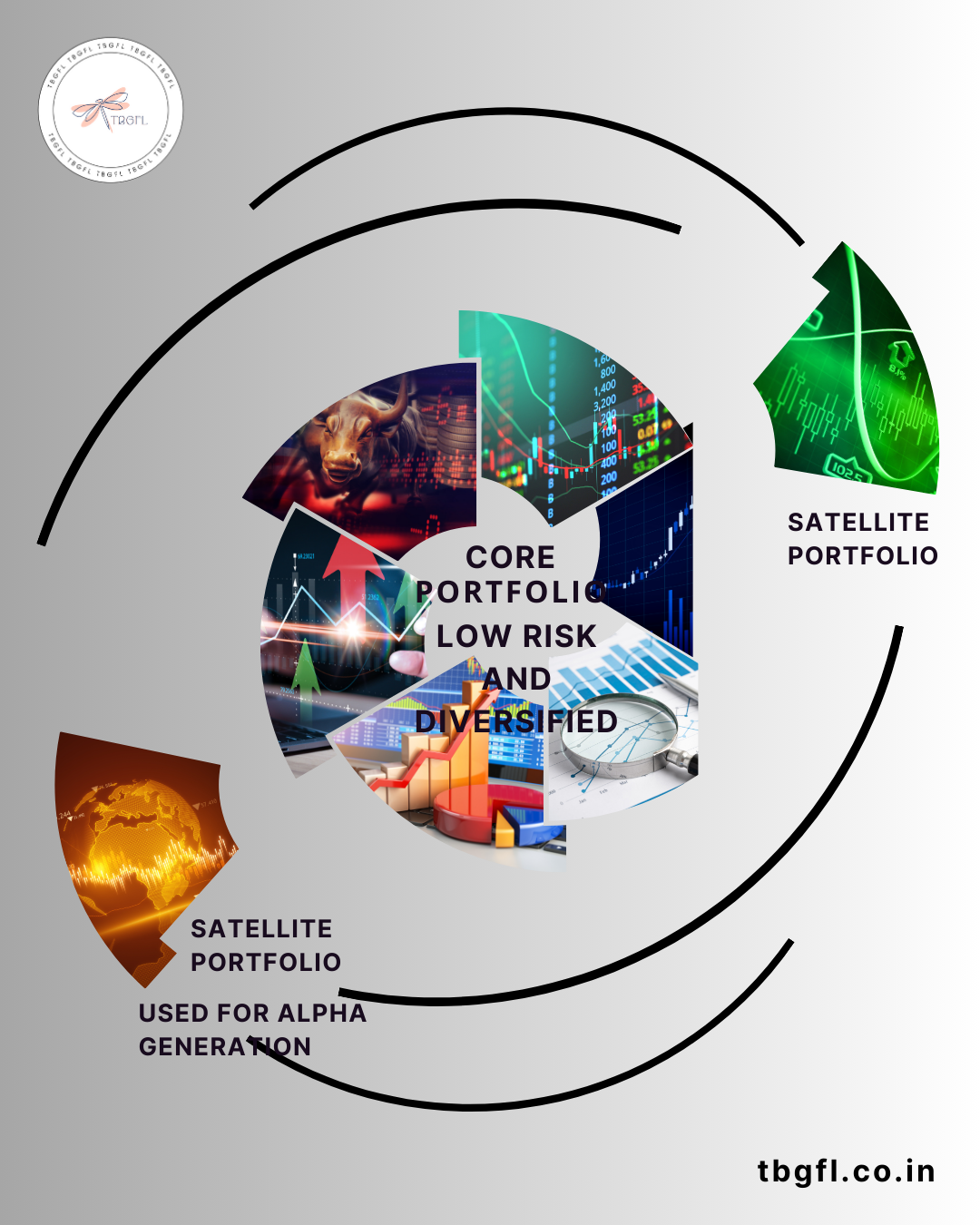
The combination of Core and Satellite portfolio is an investment strategy where the portfolio is divided into two parts one consisting of stable, diversified, and almost passively managed funds like Index funds or blue chip stocks, providing for sound foundation forming the core portion and then the satellite portion made up of more actively managed investments with higher potential returns but also higher risk, by capitalizing on specific market /economic trends or opportunities and to potentially outperformance the market.
Accordingly, Core Portfolio:
- Should be the foundation of ones investments, meant for long-term stability and wealth accumulation.
- Usually consists of low-risk, diversified assets like index funds, blue-chip stocks, large-cap mutual funds, or bonds.
- Designed for steady growth with minimal maintenance.
- Focuses on asset allocation rather than frequent trading.
- Acts as a safety net during market downturns.
And Satellite Portfolio is:
- The aggressive, potentially high-growing component of one’s portfolio.
- Typically includes high-risk, high-reward investments such as sectoral stocks, small/mid-cap funds, emerging markets, and thematic investments (like AI, EVs, biotech, etc.).
- Used for alpha generation (beating the market) rather than passive growth.
- Requires active management and periodic rebalancing.
- The timing of the investment does matter as one needs to enter at the right time in specific investments to gain from the momentum of growth cycle.
Having now the basic understanding of what these portfolio are and what may be the possible investments included therein, let us now try to understand – When is a Satellite Portfolio Beneficial?
- When one has a strong core already – One’s main portfolio should be stable before adding high-risk assets.
- For higher returns – If one aims to beat market returns, a satellite portfolio can help.
- During specific economic trends – Investing in a booming sector (e.g., AI, renewable energy) can bring high returns.
- If one has a high risk tolerance – Since satellite investments can be volatile, they suit those comfortable with market fluctuations.
- For tactical plays – When certain industries or geographies present short-term opportunities.
Industries that may be Suitable for Satellite Portfolio
- Technology (AI, Cloud, Semiconductors, Blockchain, Cybersecurity) – High growth potential.
- Healthcare & Biotech – Especially for innovations in drug discovery or genetic engineering.
- Renewable Energy (EVs, Solar, Green Hydrogen) – The world is shifting to sustainability and the sector may provide huge potential.
- Finance & FinTech – Digital payments, neo-banking, and decentralized finance.
- Consumer Discretionary & Luxury Goods – People splurge in good economic times.
- Commodities & Metals – When inflation and demand cycles are favourable.
- Emerging Markets – Developing economies with growth potential.
We all understand that a portfolio of investments is always guided by ones goals and so the next question is Should a Satellite Portfolio Be Tied to a Specific Goal or Just be a Part of the total Portfolio?
- While Both approaches work, goal-based investing ensures focus and discipline.
- Alternatively, Satellite Portfolio can be an alpha-generation strategy for enhancing overall returns.
- Your investment strategy matters – If you are scaling out sector-based investments, a satellite portfolio helps optimize the growth phase of these sectors.
When to Scale In & Out of Your Satellite Portfolio?
- Since satellite investments are more volatile, one’s investment strategy will matter – If one is scaling out sector-based investments, a satellite portfolio helps optimize the growth phase of these sectors.
✅ Scale In (Increase Allocation) When:
- The sector is in a strong uptrend (confirmed by economic cycles, government policies, or earnings growth).
- One identifies early-stage opportunities (e.g., new AI breakthroughs, fintech adoption).
- The core portfolio is performing well, allowing for more aggressive bets.
❌ Scale Out (Reduce Exposure) When:
- Sector growth slows down or shows signs of a downturn (e.g., regulatory risks, earnings decline).
- One’s portfolio allocation exceeds their risk threshold (e.g., one sector becomes too dominant).
- One achieves significant profits & wants to rebalance into core investments.
Other Key Considerations while investing in a Satellite Portfolio:
- Liquidity: Satellite investments should have an exit strategy.
- Risk Assessment: Do periodic evaluations to prevent any major losses.
- Sector Correlation: Ensure satellite investments don’t correlate too much with your core portfolio, reducing overall risk.
- Tax Efficiency: High turnover in a satellite portfolio can lead to tax implications.
- Rebalancing: Revisit the allocations as frequently as needed or at least semi-annually to keep risk in check. Adjust based on market cycles & economic outlook.
Final Thought
By combining the stability of the core with the potential upside of the satellite, a well structed core-satellite portfolio allows investors to manage risk while still pursuing higher returns. One should tweak satellite exposure based on market conditions or trends and not forget to diversify to reduce over-reliance on a single sector.
The core portfolio builds wealth slowly but surely, while the satellite portfolio gives one the thrill of high-risk, potentially high-reward opportunities. For a 8-10 year investment horizon, a well-allocated satellite component could significantly enhance ones returns while keeping risks manageable.