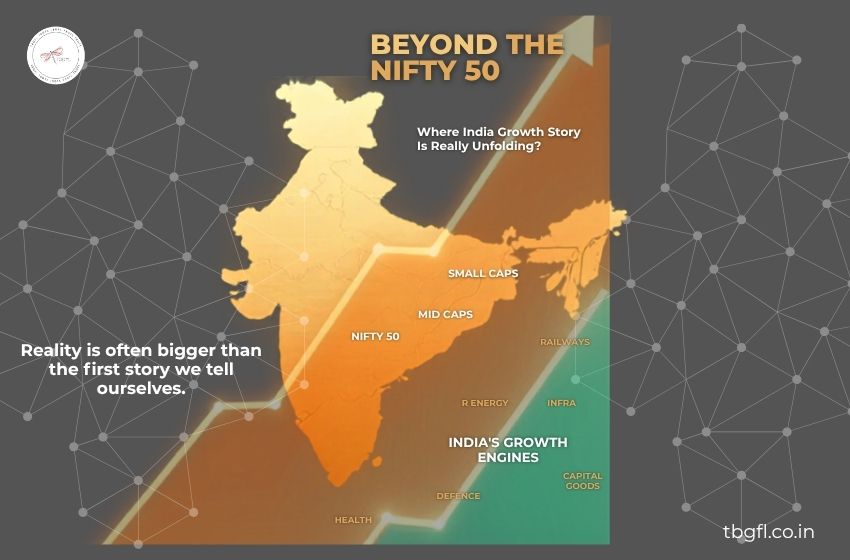
Beyond Nifty 50: Where India’s Growth Story Is Really Unfolding
For years, investors treated the Nifty 50 as a report card for India’s economic growth.
If the Nifty 50 was rising, India was doing well.
If it was struggling, investors worried about the economy.
It was simple. Convenient. Logical.
After all, the Nifty 50 consists of some of India’s largest and most established companies. If these businesses were thriving, surely the country was moving forward too.
But over the last few years, something interesting has happened.
While many investors were watching the largest companies in the country, wealth was quietly being created elsewhere.
Defence companies multiplied in value.
Capital goods businesses expanded rapidly.
Manufacturing firms became market leaders.
Railway-related businesses attracted unprecedented investor interest.
Mid-cap and small-cap stocks often delivered returns that left large caps behind.
This has led many investors to ask an important question:
Is the Nifty 50 still India’s growth story?
Or has India’s growth become too broad, too diverse and too entrepreneurial to be captured by just 50 companies?
Arjun had the same question.
So naturally, he went looking for Mr. Iyer.
What the Numbers Are Telling Us
Before we join their conversation, let’s look at what may be driving this question.
Over the last decade, broader market indices have frequently outperformed the Nifty 50.
Mid-cap companies, in particular, have often occupied a sweet spot between stability and growth. They are usually large enough to have proven business models, yet small enough to have significant room for expansion.
Small-cap companies have also delivered extraordinary wealth creation during certain phases, although accompanied by significantly higher volatility.
Meanwhile, many sectors that have become synonymous with India’s next phase of growth have emerged largely outside the traditional large-cap universe.
Consider some of the themes that have captured investor attention in recent years:
- Defence manufacturing
- Capital goods
- Railways
- Electronics Manufacturing Services (EMS)
- Renewable energy
- Logistics
- Wealth management
- Healthcare expansion
- Specialty manufacturing
Many of these businesses are still not meaningful contributors to the Nifty 50 during their early growth years.
This raises an interesting possibility.
Perhaps India’s growth story has not weakened. Perhaps it has simply become wider.
And that is where our conversation begins.
Mr. Iyer Explains: Is Nifty 50 Still India’s Growth Story?
Arjun burst into the café holding his phone.
“Mr. Iyer! I have discovered something shocking.”
Mr. Iyer looked up from his filter coffee.
“Wonderful. Last time you discovered something shocking, it was that extra cheese costs extra.”
“No, no. This is serious.”
Mr. Iyer nodded solemnly.
“My apologies. Continue.”
Arjun slid into the chair.
“Nifty 50 is no longer India’s growth story.”
Mr. Iyer took a slow sip of coffee.
“Ah. The internet told you this?”
“Everyone is saying it.”
Mr. Iyer smiled.
“Then it must be true.”
The Missing Train
Arjun opened several charts on his phone.
“Look at these returns.”
“Midcaps.”
“Small caps.”
“Defence.”
“Railways.”
“Capital goods.”
“EMS.”
“Many of them have beaten the Nifty 50 by a huge margin.”
Mr. Iyer nodded.
“Some certainly have.”
“So doesn’t that prove that Nifty 50 is outdated?”
Instead of answering, Mr. Iyer pointed outside the café.
A train was slowly passing by.
“What do you see?” he asked.
“A train.”
“What else?”
“A locomotive and several coaches.”
Mr. Iyer smiled.
“Imagine someone looked only at the locomotive and declared they had seen the entire train.”
Arjun laughed.
“That would be ridiculous.”
“Indeed.”
Mr. Iyer leaned back.
“For many years, investors looked at the Nifty 50 and assumed they were looking at the entire Indian market.”
India’s Growing Neighbourhood
Mr. Iyer took a napkin and began sketching.
“Imagine India as a city.”
“Okay.”
“Thirty years ago, the city was much smaller.”
He drew a single road.
“Most of the important businesses lived on one street.”
Arjun nodded.
“That street became the Nifty 50.”
Mr. Iyer then drew roads branching in multiple directions.
“But cities grow.”
“New neighbourhoods emerge.”
“Varied New industries develop.”
“And New entrepreneurs create new opportunities.”
He pointed to the sketch.
“Today’s India is no longer one street.”
“It is manufacturing.”
“It is defence.”
“It is digital platforms.”
“It is hospitals.”
“It is logistics.”
“It is renewable energy.”
“It is wealth management.”
“It is hundreds of businesses building tomorrow’s economy.”
Arjun looked thoughtfully at the drawing.
“So the city has become much larger than the original street.”
“Exactly.”
The Mistake Investors Often Make
Arjun smiled triumphantly.
“Then I was right. Nifty 50 is no longer relevant.”
Mr. Iyer nearly spilled his coffee.
“There it is.”
“What?”
“The human tendency to jump from one extreme to another.”
Arjun laughed.
“I do that occasionally.”
Mr. Iyer raised an eyebrow.
“Only on days ending with the letter Y.”
Where Do Giants Come From?
Near the café entrance stood a small sapling.
Mr. Iyer pointed towards it.
“What is that?”
“A young tree.”
“Wrong.”
Arjun frowned.
“What do you mean wrong?”
“It is a future large tree.”
“That’s the same thing.”
“Not quite.”
Mr. Iyer continued.
“Today’s large companies were yesterday’s midcaps.”
“Yesterday’s midcaps were once small-caps.”
“The future Nifty 50 is currently hiding somewhere outside the Nifty 50.”
Arjun paused.
That thought had never occurred to him.
“We often forget that,” Mr. Iyer continued. “We look at large companies as if they appeared fully grown.”
“But every giant was once small.”
Where India’s Growth Often Begins
“The interesting thing about economic growth,” said Mr. Iyer, “is that it rarely begins at the top.”
“It usually begins somewhere small.”
A new factory.
A new product.
A new technology.
A new entrepreneur.
A new business model.
“Some companies survive.”
“Some expand.”
“Some become market leaders.”
“Some grow into midcaps.”
“A few become large caps.”
“And an even smaller group eventually enters the Nifty 50.”
Arjun nodded.
“So growth often begins outside the Nifty 50.”
“Very often.”
“But many successful growth stories eventually end up inside the Nifty 50.”
The Garden Analogy
Mr. Iyer finished his coffee and pointed toward a small garden nearby.
“Imagine that garden represents the Indian economy.”
Arjun waited.
“The tiny plants are emerging businesses.”
“The flowering shrubs are midcaps.”
“The large trees are established leaders.”
Mr. Iyer smiled.
“Now tell me.”
“Which part of the garden contains growth?”
Arjun immediately understood.
“All of it.”
“Exactly.”
“If you only look at the large trees, you miss where new growth is emerging.”
“If you only look at the tiny plants, you ignore what successful growth eventually becomes.”
The goal was never to choose one part of the garden.
The goal was to understand the entire ecosystem.
What Investors Can Learn From This
The debate isn’t really about whether the Nifty 50 is good or bad.
It is about understanding what different indices are trying to represent.
Nifty 50: Established India
The Nifty 50 represents many of India’s most established and successful businesses.
These companies often provide stability, liquidity and resilience.
They may not always be the fastest growers, but they remain important pillars of the economy.
Nifty 500: Broader India
If the Nifty 50 is one street, the Nifty 500 is much closer to the entire city.
It captures a significantly broader representation of India’s listed businesses and economic activity.
For investors seeking exposure to India’s overall market, it may offer a more complete picture.
Midcaps: Expanding India
Mid-cap companies often represent businesses that have already proven themselves and are now scaling aggressively.
Historically, this segment has delivered some of the most attractive long-term returns.
Not because it is less risky.
But because it often balances opportunity and maturity exceptionally well.
Small caps: Emerging India
Small-cap companies represent the frontier of growth.
This is where innovation, ambition and disruption often begin.
It is also where uncertainty is highest.
The rewards can be extraordinary.
The risks can be equally significant.
Perhaps We Are Asking the Wrong Question
As investors, we often ask:
“Which index best represents India’s growth story?”
But perhaps the better question is:
“How many growth stories does India contain?”
Because the answer is not one.
It never was.
India’s growth story is unfolding simultaneously in large corporations, expanding mid-sized businesses and emerging entrepreneurial ventures.
Each index captures a different chapter of the same book.
The mistake is assuming that any single chapter tells the entire story.
Final Thoughts
As they prepared to leave, Arjun looked once more at the charts on his phone to verify the change in the composition of Nifty 50 over the decade.
Arjun looked excited.
“So almost one-third of the Nifty changed?”
Mr. Iyer nodded.
“Yes.”
“That proves my point.”
Mr. Iyer smiled.
“Which point?”
“That growth happens outside the Nifty.”
“Correct.”
Arjun grinned.
“So the Nifty misses the growth story.”
Mr. Iyer took a sip of coffee.
“Only temporarily.”
Arjun paused.
“What do you mean?”
Mr. Iyer pointed at a school nearby.
“Where do future doctors come from?”
“The school.”
“And future engineers?”
“The school.”
“And future CEOs?”
“The school.”
Mr. Iyer smiled.
“The school is where the journey begins.”
“But the corporate office is where the journey eventually arrives.”
As investors, we often search for a single number, a single index or a single chart that explains everything.
But reality is rarely that simple.
India’s growth story does not begin and end with the Nifty 50.
It begins in factories being built, entrepreneurs taking risks, businesses expanding into new markets and industries quietly transforming the economy.
Some of those companies will become tomorrow’s midcaps.
Some will become tomorrow’s large caps.
A few may eventually find their place in the Nifty 50.
The growth story was never confined to one index.
It was unfolding across the entire garden.
And perhaps that is the bigger lesson.
“Mr. Iyer, I started the day wondering whether the Nifty 50 still represents India’s growth story.”
“And where did you end the day?”
“Wondering how India’s growth story travels from small companies to midcaps to large caps and eventually into the Nifty.”
“Excellent.”
“Why excellent?”
Mr. Iyer – “Because you’ve stopped looking for answers and started looking for understanding.”
Reality is often bigger than the first story we tell ourselves.
The same is true for investing. And sometimes, the same is true for life.