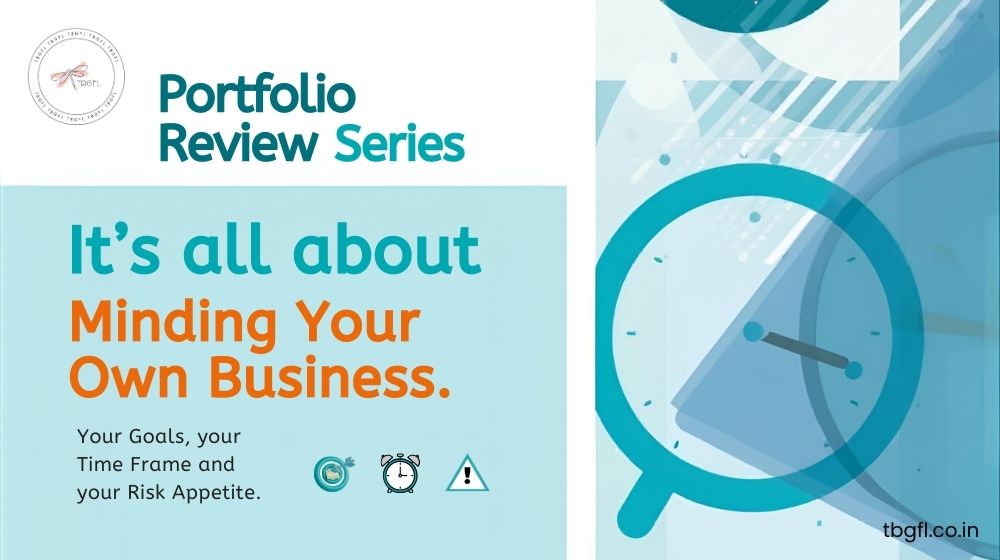
Portfolio Review Series
Minding Your Own Business – The Most Underrated Portfolio Review Strategy
In investing, one of the most difficult — and most profitable — skills to master is learning how to mind your own business.
Not the market’s business.
Not your neighbour’s portfolio.
Not the best-performing fund of the year.
Your business.
Your goals.
Your timelines.
Your appetite for risk.
And an investment strategy that reflects all of this in the truest sense.
That, in essence, is what a portfolio review is really about.
You Were Never Meant to Be at the Top Forever
Let’s start with an uncomfortable truth.
You cannot forever be invested in the top-performing mutual fund, stock, or asset class.
And that’s not a flaw.
That’s how markets work.
Every asset has seasons.
Every strategy has cycles.
Every outperformer eventually cools off.
A portfolio review is not about asking,
“Am I in the best-performing investment right now?”
It’s about asking,
“Is my portfolio doing what it was meant to do for me?”
Your Real Benchmark Was Set Long Ago
When you started investing for a goal, you made a few quiet but powerful decisions:
- You chose a time frame
- You assumed a reasonable return
- You accepted a certain level of risk
That assumed return was never random.
It was a reflection of your risk appetite.
A portfolio review, therefore, is not about chasing higher returns —
it is about checking whether your portfolio is still on track to meet that goal within that time frame.
That’s minding your own business.
When Doing Nothing Is the Right Thing
Here’s a rare but liberating outcome of a good portfolio review:
Sometimes, the correct action is no action at all.
If:
- Your portfolio is aligned with your goals
- Returns are broadly in line with expectations
- Asset allocation reflects your risk comfort
Then doing nothing is not negligence.
It is discipline.
So, Staying the course is often the most underrated investment skill.
When a Review Does Ask for Change
Of course, not all reviews end with stillness.
A mindful portfolio review studies why something feels off before reacting.
For example:
🔹 If inflation has risen
Your goal amount may have increased.
The solution may not be to exit — but to invest a little more.
🔹 If returns are lower than expected
The first step is not panic.
Compare performance with:
- Broader markets
- Relevant benchmarks
- The original strategy intent
Only then decide whether patience or adjustment is needed.
🔹 If returns are on track
Resist the temptation to “improve” something that is already working.
Consistency compounds quietly.
The Role of a Satellite Portfolio
Yes — seeking alpha is allowed.
If you enjoy deeper analysis, conviction-based bets, or thematic exposure, a satellite portfolio can have its place.
But with clear boundaries:
- A defined allocation
- Thorough understanding
- No trend chasing
- No borrowed conviction
Because frequent churn comes at a cost:
- Exit loads
- Tax leakage
- Emotional fatigue
A portfolio that is constantly changed rarely gets the gift of time.
The Peace Dividend of Staying the Course
One of the most beautiful outcomes of minding your own business in investing is peace.
Peace of not comparing.
Peace of not reacting.
Peace of knowing why you are invested the way you are.
A portfolio built with awareness allows you to enjoy the journey — not just obsess over the destination.
Summarising the key insights:
1️⃣ You Were Never Meant to Be in the Top-Performing Asset Forever
This is a huge mindset unlock. When you accept this, it means you truly understand
- Every asset has seasons
- Every strategy has cycles
- Being “average but consistent” often wins
This approach – normalises underperformance within a plan — not as failure, but a reflection of how markets work and that returns compound with time and discipline.
2️⃣ Goals, Timelines & Assumed Returns Are the Real Benchmarks
When you set a goal, you already assumed:
-
- a return range
- a risk level
- a timeline
👉 Portfolio review = checking alignment with that original intent
Not with:
- Last year’s top fund
- Your friend’s portfolio
- Social media screenshots
That’s minding your own business in its purest form.
3️⃣ “Do Nothing” Is Often the Right Action
This may seem deeply counter-intuitive — but is often the wise thing to do.
What this framework advocates is:
- If portfolio is on track → do nothing
- If inflation has shifted goal → invest more
- If returns are lower → diagnose before exiting
- If markets are noisy → zoom out, compare with benchmarks
This teaches that – Action should be a response to misalignment, not discomfort.
4️⃣ Satellite Portfolio = Optional, Conscious, Contained
A well planned portfolio should actually have an exposure for potential alpha returns:
- Experimentation is allowed, BUT:
- Only with understanding
- Only in a defined satellite portion
- Never by chasing trends
And Finally, One should be aware of certain costs associated with frequent exists from investments, that may impact the overall returns over the years.
- Exit loads
- Taxes
- Emotional fatigue
Closing Reflection
A portfolio review is not about finding the best investment.
It is about ensuring that your investments are still aligned with:
- Your goals
- Your timelines
- Your risk truth
When you mind your own business,
markets become less noisy,
decisions become clearer,
and investing becomes lighter.
And often, that is when wealth — both financial and emotional — truly compounds.