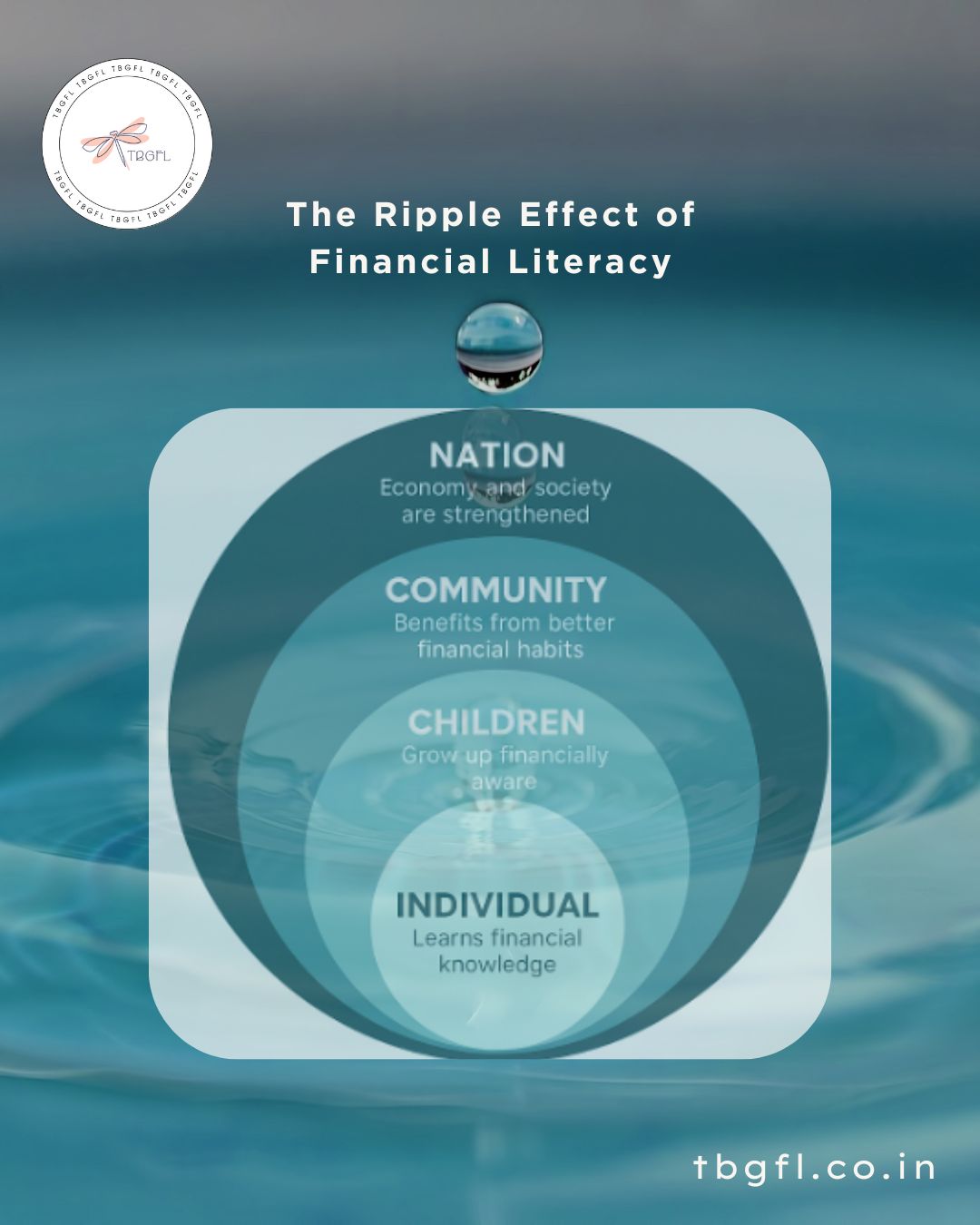
🌊 The Ripple Effect of Financial Literacy: A Conversation That Changed Arjun’s Perspective
“One financially aware individual can change a family. One aware family can shift a community. That’s how legacies are built.”
– Mr. Iyer
🪑 Scene: A Park Bench, Two Cups of Chai, and a Conversation
A sunny morning in the neighbourhood park. Squirrels chase each other, uncles debate cricket stats, and the chai wala pours steaming cups.
Arjun is deep in thought while Mr. Iyer is watching a group of kids playing nearby.
Arjun (leaning back):
“Mr. Iyer, you always say financial literacy is powerful and is there so much noise around financial literacy these days? I mean, okay, it’s useful, but is it really that big a deal? Is it really that important beyond just managing your own money?”
Mr. Iyer (smiling):
Ah, Arjun. You are seeing just the pebble, but not the ripples it creates. Financial literacy is not just about budgeting or investing.
Understanding money management can shape your future, your child’s mindset, your community’s habits—and even impact the country’s economy.
Arjun (raising an eyebrow):
Come on… a bit dramatic, don’t you think?
Mr. Iyer:
Not at all. Let me tell you a little story—not from a book, but from life.
🏡 It Starts at Home: The First Circle
Meet Meera. She’s a schoolteacher and a single mother. Her income isn’t huge, but she learned about budgeting, emergency funds, and the magic of compounding through a community workshop. She began tracking her expenses, set aside savings every month, and started a SIP of just ₹500.
Slowly, things changed. Her stress about bills reduced. Her son, Aditya, saw her prioritize needs over wants, and learned to do the same. When he turned 10, Meera gave him a piggy bank and taught him how to set aside a part of his pocket money and explained why saving matters.
That’s where it began—quietly. 💡 The foundation set – Quietly, but powerfully.
👦🏽 The Second Circle: Children Who Think Differently
Aditya grew up understanding that money is a tool, not a master. He didn’t fear it, nor chase it blindly. At school, when his friends talked about the latest gadgets, he talked about saving up for his own cycle.
His teachers noticed his sense of responsibility. Other children began asking him how he managed his “money jar.” Soon, the school introduced a basic money habits session for all students.
See what happened there, Arjun? Mr. Iyer pauses.
Arjun (slowly):
Meera’s financial literacy influenced her son… who then influenced his classmates and school.
Yes Mr. Iyer said – “One aware child can influence many more. That’s how culture shifts—one person at a time.”
🏘 The Third Circle: A Community that Begins to Shift
The ripple grows.
Inspired by the children, the school collaborated with a local NGO to host financial awareness sessions for parents. Attendance wasn’t mandatory—but the sessions were packed.
People who had once feared banking began opening accounts. Young mothers discussed how they could start saving even from modest incomes. Teenagers started learning about investing and budgeting.
💬 Money talk becomes normal. Empowering. Shared.
🌏 The Fourth Circle: Society Gains Muscle
Financially literate communities are empowered communities. They:
- Fall prey less often to scams.
- Demand better financial products and services.
- Understand budgets and economic policies better.
- Make informed decisions from EMIs to elections.
- Raise financially confident children who become responsible adults.
When enough individuals and families move from financial confusion to clarity, the economy benefits. Savings grow. Consumption is smarter. Long-term investing increases. Insurance penetration improves. The burden on welfare systems reduces.
Arjun (amazed):
It’s like a chain reaction—from one conscious individual to national development.
Mr. Iyer (smiling):
And it all started with one aware mother, choosing to educate herself about money.
Mr. Iyer (quotes smiling):
“When money stops being a monster in people’s minds, it becomes a tool for good.”
🌐 The Fifth Circle: A More Equitable World
Now imagine if every parent learnt the tools to manage money, Every child would grow up financially aware. Every family would have a plan, not panic, when financial surprises hit.
- Generational impact: Kids become confident, responsible, and free of financial anxiety.
- Global equity: Global inequality wouldn’t vanish overnight—but it would shrink.
Financially aware individuals don’t just lift themselves—they carry generations with them.
Mr Iyer – “And guess what, Arjun? It’s not about being rich. It’s about being aware. The ripple has already started – in households that choose awareness.”
🔄 Back to the Park…
Arjun (quietly):
“I used to think financial literacy was about numbers… but it’s about legacy, dignity, and decisions that last generations.”
Mr. Iyer (nodding):
“Financial literacy is the root. Security, freedom, and opportunity—they are the fruits.
Eventually it would be wonderful to see the financial awareness becoming the innate knowing of mankind.”
So, next time someone says, “It’s just money stuff,” smile and tell them—
“Money stuff changes everything.”
✅ Takeaway: Be the Ripple
🔹 Start with yourself – Track, budget, plan. Awareness is the first step. Learn, Unlearn and grow financially.
🔹 Talk money at home – Involve your partner, your children. Build the next generation.
🔹 Spread it – Share what you know. Encourage your community.
🔹 Support education – Whether through schools, NGOs, or your workplace—every initiative counts.
🔹 Never underestimate your impact – You may not see the full ripple. But someone, somewhere will feel it.
As Arjun and Mr. Iyer finish their chai, a little girl runs up to them, proudly showing her piggy bank. Mr. Iyer smiles and winks at Arjun.
The ripple had already begun.
💬 Let’s Pass It On
If this story resonates with you, share the blog link with a parent, a teacher, or a friend who might be the start of their own ripple.
Because when we build financially aware homes, we build a stronger nation.